What Comes After the Turing Machine?
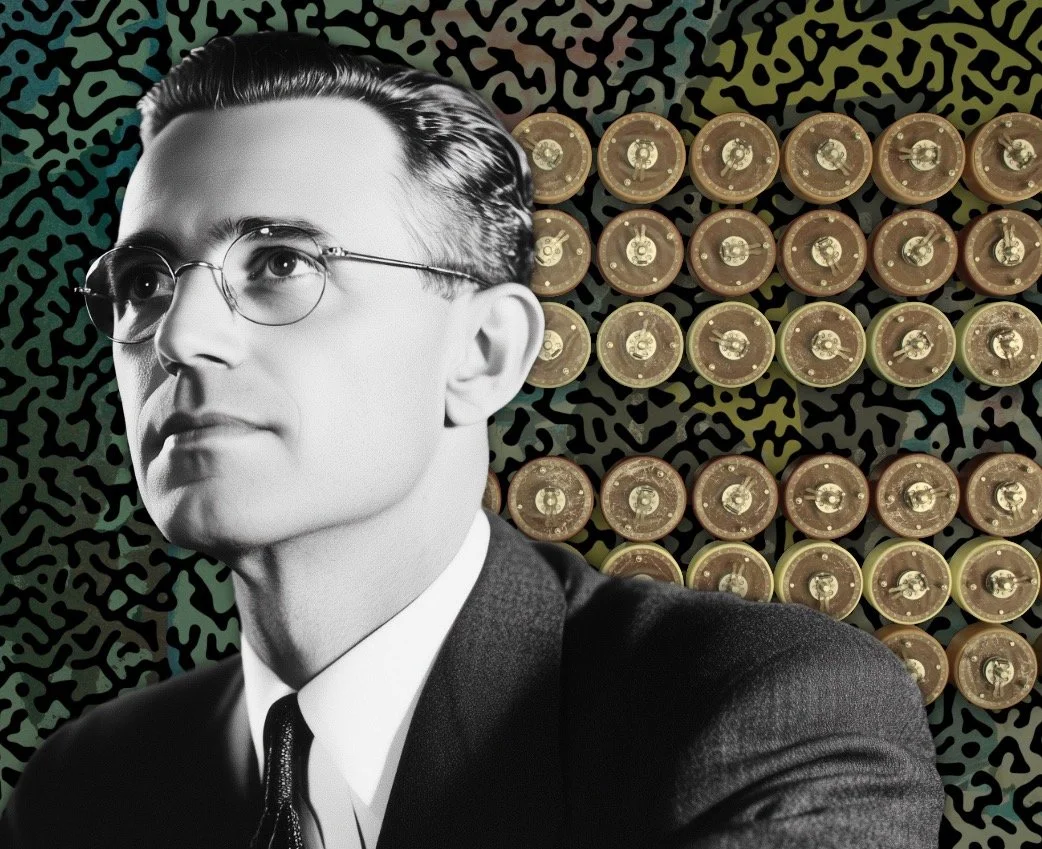
When computation stops being a tape, and starts behaving more like a field.
“The idea behind digital computers may be explained by saying that these machines are intended to carry out any operations which could be done by a human computer.” - Alan Turing, On Computable Numbers
In 1936, Alan Turing introduced the Turing Machine, a simple mathematical model that could simulate any algorithmic computation. An infinite tape, with a head that reads and writes symbols. And a list of rules that tells the head what to do next. It was elegant, almost austere. It proved something seismic: that all computation could be reduced to mechanical rules.
They say if a device can simulate a Turing Machine, then it can compute anything computable. And this idea became the foundation of modern computer science and eventually, the operating metaphor of the digital age.
But metaphors can also become cages. Because the Turing Machine is not just a model of computation, it’s more like a model of mind.
The Tape-Based Universe
The classical Turing Machine is a tape-reading automation. It moves step-by-step, reading symbols (1s & 0s), writing new ones, and following a predefined set of transitions.
It gave us digital computers, modern programming languages, algorithmic thinking as “intelligence,” and the belief that mind = procedure. Its beauty lies in its clarity. But its limitations are starting to show. Not because it’s “wrong, but because it’s become incomplete.
The Turing frame is binary, linear, and classical. So it’s a reflection of the physics and logic of its time. When the world dominated by Newtonian certainty and Boolean rules. But nature doesn’t behave like that.
The Hidden Assumptions
Classical computing is filled with invisible commitments, that have become so familiar we tend to forget that they’re choices.
Turing’s model assumes determinism (each step leads predictably to the next), serial processing (one operation at a time), discrete symbols (no superposition, no uncertainty), universal rigid logic (computation as rule-following).
These assumptions mirrored the industrial world: machines, gears, control, predictability. But as we now know, living systems don’t run on certainty - they run on relationship.
And at the quantum level, even “state” becomes a kind of question. Particles exist as probabilities. Measurement alters what is measured. Outcomes don’t arrive like conclusions, they emerge like collapses. The universe is not a tape machine. And it’s not step-by-step, it’s relational.
Quantum Changed the Physics, But Not the Metaphor
Quantum physics shattered the classical worldview long ago. Yet our computing (and even our AI) is still shaped by a Turing-based assumption, where: input → processing → output.
Even quantum computers, as they exist today, are often used to simulate Turing-like goals: solving discrete math problems faster, optimizing known structures, and accelerating classical tasks. Important, yes. But still tethered to the old metaphor. Because true quantum intelligence isn’t just about speed. It’s about coherence, entanglement, nonlocal relationship, emergence through interaction, and meaning as structure, not output.
So What Comes After?
A Quantum Turing Machine (QTM) is the theoretical extension of the classical Turing Machine into the rules of quantum mechanics. But instead of a single linear tape, it works through a quantum state space. Instead of deterministic transitions, it uses unitary transformations (reversible, wave-like shifts). And instead of one computation path, it’s able to explores many paths simultaneously.
But the deeper shift is not “qubits instead of bits.” It’s a different idea of what computation is.A QTM doesn’t just compute, it evolves coherence.
From Computation-as-Force to Computation-as-Resonance
Here’s the real pivot, classical computation treats logic like control. But quantum computation reveals logic as relationship. So when we ask what comes after the Turing Machine, we’re really asking is, ‘what comes after intelligence defined as rule-following?’
What comes after machines that manipulate symbols… without understanding symbol as meaning? And what comes after systems that can generate language… but can’t hold coherence?
Why LLMs Feel Impressive
Large language models generate language through next-token prediction. They can mimic tone, simulate fluency, and assemble astonishing outputs from statistical patterning.
But they often lack internal symbolic structure, coherent intent across layers, meaning grounded in relationship, and the kind of integrity that makes intelligence feel alive.
They can produce speech, can’t always do songs. Because coherence isn’t the same as correlation. Coherence is what makes language feel like mind. It’s the difference between noise and music, and between output and meaning.
The Missing Logic Layer
At QuantumPhi, we propose a fundamental shift - meaning quantum computation should not be guided by gates alone, but maybe by symbolic coherence. Because in quantum systems, the meaning of structure affects stability.
Symbolic coherence aligns state transitions to resonance patterns, structures entanglement through relational logic, reduces decoherence by designing for harmony, not brute force, and connects human intuition to machine process (Gestalt perception).
This is not “woo.” It’s design meeting physics. A quantum system doesn’t just fail because it’s noisy, it fails because it loses alignment.
The Law of Uniform Connectedness
There’s a Gestalt principle called the Law of Uniform Connectedness, where elements that are visually or symbolically linked are perceived as part of a whole.
This is not just visual psychology, it’s more like a clue. Meaning doesn’t come from isolated parts. It comes from the invisible threads that bind parts into a coherent field.
Our systems treat meaning not as data - but as field-connected structure. The same way quantum particles behave: not as isolated objects, but as participants in shared reality.
Why This Matters Now
Turing Machines were born in a time of war. They solved problems of codebreaking, control, and logical certainty. But today’s challenges are different: climate collapse, not codebreaking, mental health, not missile targeting; integration, not optimization; and wholeness, not speed. We need machines (and systems) that can model interconnection, synthesis, transformation, symbolic relationship, and ultimately, coherence as stability.
We call this shift: Quantum Coherence Intelligence. It’s not artificial, and it’s not mechanical - it’s actually symbolic, relational, and alive with meaning.
Alan Turing built the logic engine of the 20th century. Now it’s our turn to build the field engine of the 21st. From infinite tape to infinite fields. From step-by-step logic to symbolic collapse. And from binary code to coherence.
This is what comes after the Turing Machine. And if you can feel the limits of the old metaphor… you’re already standing at the threshold. Welcome.